Leetcode 题解 - 哈希表
哈希表使用 O(N) 空间复杂度存储数据,查找、插入的平均时间复杂度为 O(1),用空间换时间。
Java 中的 HashSet 用于存储一个集合,可以查找元素是否在集合中。如果元素有穷,并且范围不大,那么可以用一个布尔数组来存储一个元素是否存在。例如对于只有小写字符的元素,就可以用一个长度为 26 的布尔数组来存储一个字符集合,使得空间复杂度降低为 O(1)。
Java 中的 HashMap 主要用于映射关系,从而把两个元素联系起来。HashMap 也可以用来对元素进行计数统计,此时键为元素,值为计数。和 HashSet 类似,如果元素有穷并且范围不大,可以用整型数组来进行统计。在对一个内容进行压缩或者其它转换时,利用 HashMap 可以把原始内容和转换后的内容联系起来。例如在一个简化 url 的系统中(535. Encode and Decode TinyURL (Medium),Leetcode / 力扣),利用 HashMap 就可以存储精简后的 url 到原始 url 的映射,使得不仅可以显示简化的 url,也可以根据简化的 url 得到原始 url 从而定位到正确的资源。
1. 数组中两个数的和为给定值
1. Two Sum (Easy)
可以先对数组进行排序,然后使用双指针方法或者二分查找方法,时间复杂度为 O(NlogN)。需要注意的是,题目要求返回原数组的下标,排序会打乱下标,因此要把元素和原下标一起排序,空间复杂度为 O(N)。
用 HashMap 存储数组元素和索引的映射,在访问到 nums[i] 时,判断 HashMap 中是否存在 target - nums[i],如果存在说明 target - nums[i] 所在的索引和 i 就是要找的两个数。该方法的时间复杂度为 O(N),空间复杂度为 O(N),使用空间来换取时间。
public int[] twoSum(int[] nums, int target) {
    HashMap<Integer, Integer> indexForNum = new HashMap<>();
    for (int i = 0; i < nums.length; i++) {
        if (indexForNum.containsKey(target - nums[i])) {
            return new int[]{indexForNum.get(target - nums[i]), i};
        } else {
            indexForNum.put(nums[i], i);
        }
    }
    return null;
}
2. 判断数组是否含有重复元素
217. Contains Duplicate (Easy)
public boolean containsDuplicate(int[] nums) {
    Set<Integer> set = new HashSet<>();
    for (int num : nums) {
        set.add(num);
    }
    return set.size() < nums.length;
}
3. 最长和谐序列
594. Longest Harmonious Subsequence (Easy)
Input: [1,3,2,2,5,2,3,7]
Output: 5
Explanation: The longest harmonious subsequence is [3,2,2,2,3].
和谐序列中最大数和最小数之差正好为 1,需要注意的是序列的元素不一定是数组的连续元素。统计每个数出现的次数,对每个 num,只有 num + 1 也存在时,两者的次数之和才是以它们为最小、最大值的和谐序列长度。
public int findLHS(int[] nums) {
    Map<Integer, Integer> countForNum = new HashMap<>();
    for (int num : nums) {
        countForNum.put(num, countForNum.getOrDefault(num, 0) + 1);
    }
    int longest = 0;
    for (int num : countForNum.keySet()) {
        if (countForNum.containsKey(num + 1)) {
            longest = Math.max(longest, countForNum.get(num + 1) + countForNum.get(num));
        }
    }
    return longest;
}
4. 最长连续序列
128. Longest Consecutive Sequence (Medium)
Given [100, 4, 200, 1, 3, 2],
The longest consecutive elements sequence is [1, 2, 3, 4]. Return its length: 4.
要求以 O(N) 的时间复杂度求解,因此不能排序。
把所有数放进 HashSet,只从每段连续序列的起点开始向后数:num - 1 不在集合中时,num 是起点,依次查找 num + 1、num + 2……直到断开。例如 4 不是起点(3 在集合中),跳过;1 是起点,向后数到 4,长度为 4。每个数只会在它所在序列的起点被数到一次,总的时间复杂度为 O(N)。
public int longestConsecutive(int[] nums) {
    Set<Integer> set = new HashSet<>();
    for (int num : nums) {
        set.add(num);
    }
    int longest = 0;
    for (int num : set) {
        if (set.contains(num - 1)) {
            continue; // num 不是一段连续序列的起点
        }
        int end = num;
        while (set.contains(end + 1)) {
            end++;
        }
        longest = Math.max(longest, end - num + 1);
    }
    return longest;
}
需要注意的是,遍历的是 set 而不是 nums:nums 中同一个起点重复出现很多次时,遍历 nums 会把同一段序列重复数很多遍。
5. 和为 K 的子数组
560. Subarray Sum Equals K (Medium)
Input: nums = [1, 1, 1], k = 2
Output: 2
题目描述:统计和为 k 的连续子数组个数,数组元素可能为负数。
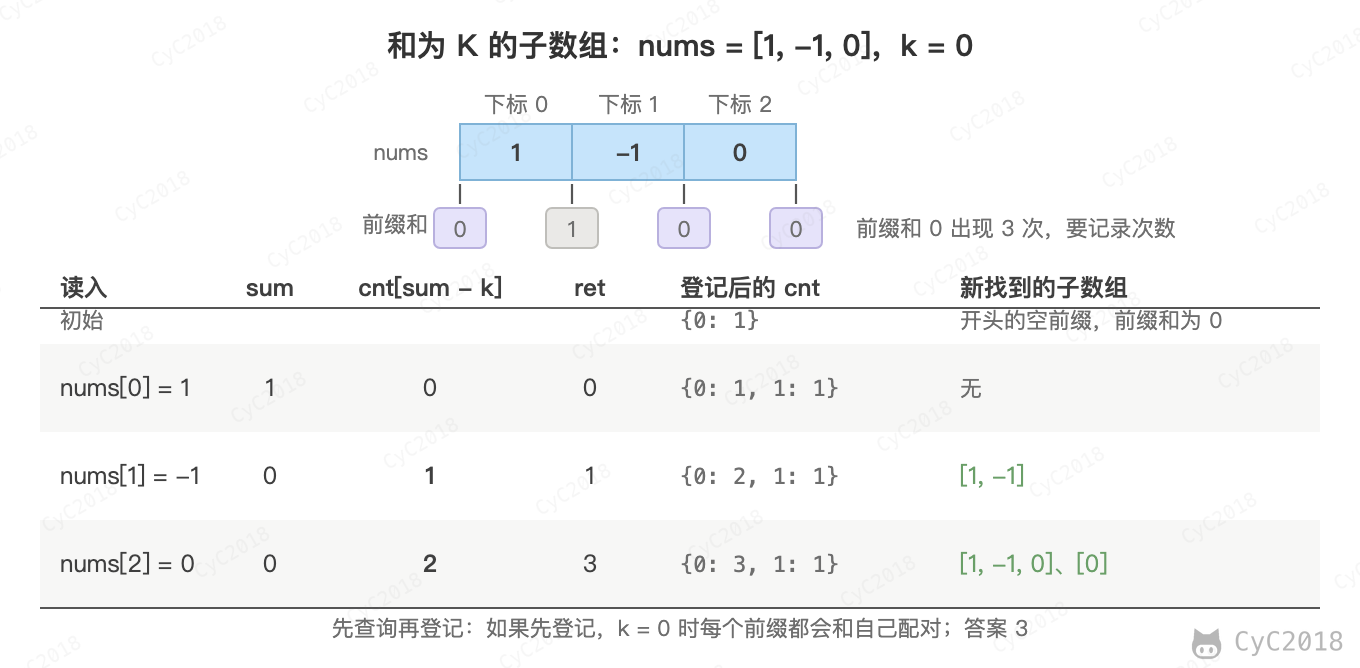
用 sum 表示从数组开头到当前位置的前缀和,以当前位置结尾、和为 k 的子数组,对应前面某个位置的前缀和为 sum - k。遍历时用哈希表记录每个前缀和出现的次数即可。数组中有负数,窗口变大时和不一定变大,因此不能用滑动窗口。
有两处容易写错:
- 开始时放入前缀和 0、次数 1,表示数组开始之前的空前缀,这样从下标 0 开始的子数组也能被统计;
- 先查询 sum - k、再登记当前的 sum,保证配对的是更早的前缀,否则 k = 0 时当前前缀会和自己配对。
哈希表记录的是次数而不是是否出现,因为同一个前缀和可能出现多次,每一次都对应一个不同的子数组。例如 nums = [1, -1, 0]、k = 0:
public int subarraySum(int[] nums, int k) {
    Map<Integer, Integer> cnt = new HashMap<>();
    cnt.put(0, 1);
    int sum = 0, ret = 0;
    for (int num : nums) {
        sum += num;
        ret += cnt.getOrDefault(sum - k, 0);
        cnt.merge(sum, 1, Integer::sum);
    }
    return ret;
}