Leetcode 题解 - 图
二分图
如果可以用两种颜色对图中的节点进行着色,并且保证相邻的节点颜色不同,那么这个图就是二分图。
1. 判断是否为二分图
785. Is Graph Bipartite? (Medium)
Input: [[1,3], [0,2], [1,3], [0,2]]
Output: true
Explanation:
The graph looks like this:
0----1
|    |
|    |
3----2
We can divide the vertices into two groups: {0, 2} and {1, 3}.
Example 2:
Input: [[1,2,3], [0,2], [0,1,3], [0,2]]
Output: false
Explanation:
The graph looks like this:
0----1
| \  |
|  \ |
3----2
We cannot find a way to divide the set of nodes into two independent subsets.
从一个未着色的节点开始 DFS,给它涂色 0,它的邻居涂色 1,邻居的邻居再涂色 0。如果遇到一个已经着色的节点,颜色与应该涂的颜色不同,就说明有两个相邻节点必须同色,不是二分图。例 2 中 0 涂色 0、1 涂色 1、2 涂色 0,而 2 与 0 相邻,矛盾。
public boolean isBipartite(int[][] graph) {
    int[] colors = new int[graph.length];
    Arrays.fill(colors, -1);
    for (int i = 0; i < graph.length; i++) {  // 处理图不是连通的情况
        if (colors[i] == -1 && !isBipartite(i, 0, colors, graph)) {
            return false;
        }
    }
    return true;
}

private boolean isBipartite(int curNode, int curColor, int[] colors, int[][] graph) {
    if (colors[curNode] != -1) {
        return colors[curNode] == curColor;
    }
    colors[curNode] = curColor;
    for (int nextNode : graph[curNode]) {
        if (!isBipartite(nextNode, 1 - curColor, colors, graph)) {
            return false;
        }
    }
    return true;
}
拓扑排序
拓扑排序指的是把有向无环图的节点排成一个序列,使得每条边 u → v 中 u 都排在 v 的前面,常用于有先后依赖的任务规划,例如安排课程的学习顺序。图中有环时不存在拓扑排序。
1. 课程安排的合法性
207. Course Schedule (Medium)
2, [[1,0]]
return true
2, [[1,0],[0,1]]
return false
题目描述:一个课程可能会先修课程,判断给定的先修课程规定是否合法。
本题不需要使用拓扑排序,只需要检测有向图是否存在环即可。
用 DFS 检测环时,节点有三种状态:没访问过;在当前的递归路径上(localMarked 为 true);已经访问完并且确认从它出发没有环(只有 globalMarked 为 true)。沿着边走到一个仍在当前路径上的节点,说明绕回了自己,存在环。只用一个 visited 数组无法区分后两种状态,例如 0 → 1、0 → 2、2 → 1 中,从 2 走到 1 时 1 已经访问过,但没有环。
public boolean canFinish(int numCourses, int[][] prerequisites) {
    List<Integer>[] graphic = new List[numCourses];
    for (int i = 0; i < numCourses; i++) {
        graphic[i] = new ArrayList<>();
    }
    for (int[] pre : prerequisites) {
        graphic[pre[0]].add(pre[1]);
    }
    boolean[] globalMarked = new boolean[numCourses];
    boolean[] localMarked = new boolean[numCourses];
    for (int i = 0; i < numCourses; i++) {
        if (hasCycle(globalMarked, localMarked, graphic, i)) {
            return false;
        }
    }
    return true;
}

private boolean hasCycle(boolean[] globalMarked, boolean[] localMarked,
                         List<Integer>[] graphic, int curNode) {

    if (localMarked[curNode]) {
        return true;
    }
    if (globalMarked[curNode]) {
        return false;
    }
    globalMarked[curNode] = true;
    localMarked[curNode] = true;
    for (int nextNode : graphic[curNode]) {
        if (hasCycle(globalMarked, localMarked, graphic, nextNode)) {
            return true;
        }
    }
    localMarked[curNode] = false;
    return false;
}
2. 课程安排的顺序
210. Course Schedule II (Medium)
4, [[1,0],[2,0],[3,1],[3,2]]
There are a total of 4 courses to take. To take course 3 you should have finished both courses 1 and 2. Both courses 1 and 2 should be taken after you finished course 0. So one correct course order is [0,1,2,3]. Another correct ordering is[0,2,1,3].
使用 DFS 来实现拓扑排序:在一个节点的所有后继都访问完之后,再把它放入后序遍历的结果,也就是 postOrder.push(curNode) 所在的位置。
对于任何一条边 v->w,后序遍历可以保证 w 先于 v 进入结果,因此后序遍历结果的逆序就是拓扑排序。代码中的边从课程指向它的先修课程(graphic[pre[0]].add(pre[1])),先修课程会先进入后序结果,所以按入栈的顺序输出就是可行的上课顺序,不需要再逆序。以输入为例,从 0 出发时 0 没有先修课程,0 先入栈;从 1 出发时先修课程 0 已访问,1 入栈;随后是 2、3,结果为 [0,1,2,3]。
public int[] findOrder(int numCourses, int[][] prerequisites) {
    List<Integer>[] graphic = new List[numCourses];
    for (int i = 0; i < numCourses; i++) {
        graphic[i] = new ArrayList<>();
    }
    for (int[] pre : prerequisites) {
        graphic[pre[0]].add(pre[1]);
    }
    Stack<Integer> postOrder = new Stack<>();
    boolean[] globalMarked = new boolean[numCourses];
    boolean[] localMarked = new boolean[numCourses];
    for (int i = 0; i < numCourses; i++) {
        if (hasCycle(globalMarked, localMarked, graphic, i, postOrder)) {
            return new int[0];
        }
    }
    int[] orders = new int[numCourses];
    for (int i = numCourses - 1; i >= 0; i--) {
        orders[i] = postOrder.pop();
    }
    return orders;
}

private boolean hasCycle(boolean[] globalMarked, boolean[] localMarked, List<Integer>[] graphic,
                         int curNode, Stack<Integer> postOrder) {

    if (localMarked[curNode]) {
        return true;
    }
    if (globalMarked[curNode]) {
        return false;
    }
    globalMarked[curNode] = true;
    localMarked[curNode] = true;
    for (int nextNode : graphic[curNode]) {
        if (hasCycle(globalMarked, localMarked, graphic, nextNode, postOrder)) {
            return true;
        }
    }
    localMarked[curNode] = false;
    postOrder.push(curNode);
    return false;
}
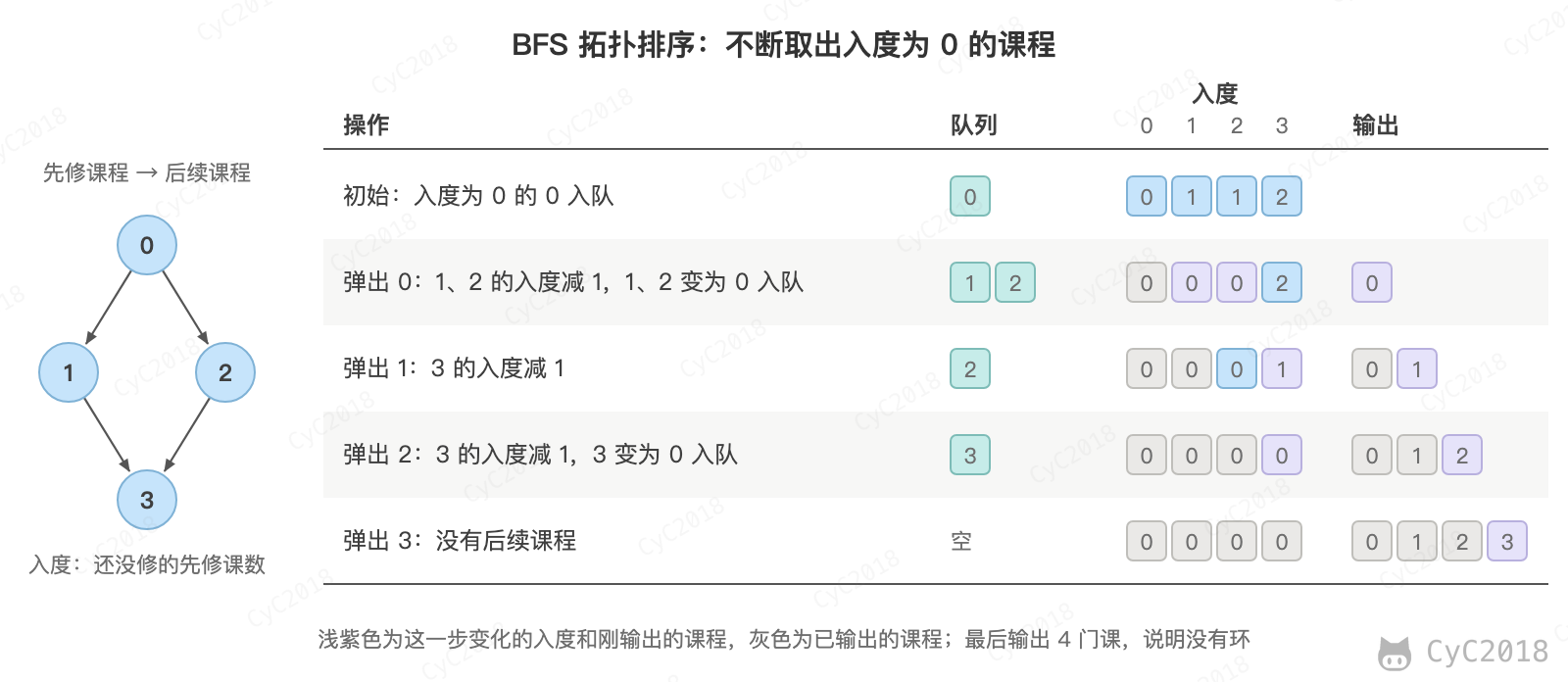
拓扑排序也常用 BFS 实现(Kahn 算法)。这时边从先修课程指向后续课程,节点的入度就是还没修的先修课程数。入度为 0 的课程可以直接上,把它们放入队列;每取出一门课程,就把它指向的课程入度减 1,减到 0 的放入队列。如果最后输出的课程少于 numCourses,说明图中有环:环上的课程,以及依赖环上课程的课程,入度始终减不到 0。
public int[] findOrder(int numCourses, int[][] prerequisites) {
    List<Integer>[] graphic = new List[numCourses];
    for (int i = 0; i < numCourses; i++) {
        graphic[i] = new ArrayList<>();
    }
    int[] inDegree = new int[numCourses];
    for (int[] pre : prerequisites) {
        graphic[pre[1]].add(pre[0]); // 边从先修课程指向后续课程
        inDegree[pre[0]]++;
    }
    Queue<Integer> queue = new LinkedList<>();
    for (int i = 0; i < numCourses; i++) {
        if (inDegree[i] == 0) {
            queue.add(i);
        }
    }
    int[] orders = new int[numCourses];
    int cnt = 0;
    while (!queue.isEmpty()) {
        int cur = queue.poll();
        orders[cnt++] = cur;
        for (int next : graphic[cur]) {
            if (--inDegree[next] == 0) {
                queue.add(next);
            }
        }
    }
    return cnt == numCourses ? orders : new int[0];
}
并查集
并查集可以动态地连通两个点,并且可以非常快速地判断两个点是否连通。
1. 冗余连接
684. Redundant Connection (Medium)
Input: [[1,2], [1,3], [2,3]]
Output: [2,3]
Explanation: The given undirected graph will be like this:
  1
 / \
2 - 3
题目描述:有一系列的边连成的图,找出一条边,移除它之后该图能够成为一棵树。
按顺序加边,用并查集记录哪些节点已经连通。如果一条边的两个端点在加它之前就已经连通,这条边就形成了环,是多余的边。图中只有一个环,环上最后加入的边就是第一次检测到的这条边,满足题目“有多个答案时返回最后出现的边”的要求。这里的并查集是最简单的 Quick Find 实现,更快的实现见算法 - 并查集。
public int[] findRedundantConnection(int[][] edges) {
    int N = edges.length;
    UF uf = new UF(N);
    for (int[] e : edges) {
        int u = e[0], v = e[1];
        if (uf.connect(u, v)) {
            return e;
        }
        uf.union(u, v);
    }
    return new int[]{-1, -1};
}

private class UF {

    private int[] id;

    UF(int N) {
        id = new int[N + 1];
        for (int i = 0; i < id.length; i++) {
            id[i] = i;
        }
    }

    void union(int u, int v) {
        int uID = find(u);
        int vID = find(v);
        if (uID == vID) {
            return;
        }
        for (int i = 0; i < id.length; i++) {
            if (id[i] == uID) {
                id[i] = vID;
            }
        }
    }

    int find(int p) {
        return id[p];
    }

    boolean connect(int u, int v) {
        return find(u) == find(v);
    }
}
参考资料
- LeetCode 题库
- Sedgewick R, Wayne K. 算法(第 4 版)[M]. 人民邮电出版社, 2012.