Leetcode 题解 - 数组与矩阵
本文目录
1. 把数组中的 0 移到末尾
283. Move Zeroes (Easy)
For example, given nums = [0, 1, 0, 3, 12], after calling your function, nums should be [1, 3, 12, 0, 0].
public void moveZeroes(int[] nums) {
    int idx = 0;
    for (int num : nums) {
        if (num != 0) {
            nums[idx++] = num;
        }
    }
    while (idx < nums.length) {
        nums[idx++] = 0;
    }
}
2. 改变矩阵维度
566. Reshape the Matrix (Easy)
Input:
nums =
[[1,2],
 [3,4]]
r = 1, c = 4

Output:
[[1,2,3,4]]

Explanation:
The row-traversing of nums is [1,2,3,4]. The new reshaped matrix is a 1 * 4 matrix, fill it row by row by using the previous list.
public int[][] matrixReshape(int[][] nums, int r, int c) {
    int m = nums.length, n = nums[0].length;
    if (m * n != r * c) {
        return nums;
    }
    int[][] reshapedNums = new int[r][c];
    int index = 0;
    for (int i = 0; i < r; i++) {
        for (int j = 0; j < c; j++) {
            reshapedNums[i][j] = nums[index / n][index % n];
            index++;
        }
    }
    return reshapedNums;
}
3. 找出数组中最长的连续 1
485. Max Consecutive Ones (Easy)
public int findMaxConsecutiveOnes(int[] nums) {
    int max = 0, cur = 0;
    for (int x : nums) {
        cur = x == 0 ? 0 : cur + 1;
        max = Math.max(max, cur);
    }
    return max;
}
4. 有序矩阵查找
240. Search a 2D Matrix II (Medium)
Input:
matrix = [
  [ 1,  4,  7, 11, 15],
  [ 2,  5,  8, 12, 19],
  [ 3,  6,  9, 16, 22],
  [10, 13, 14, 17, 24],
  [18, 21, 23, 26, 30]
], target = 14

Output: true
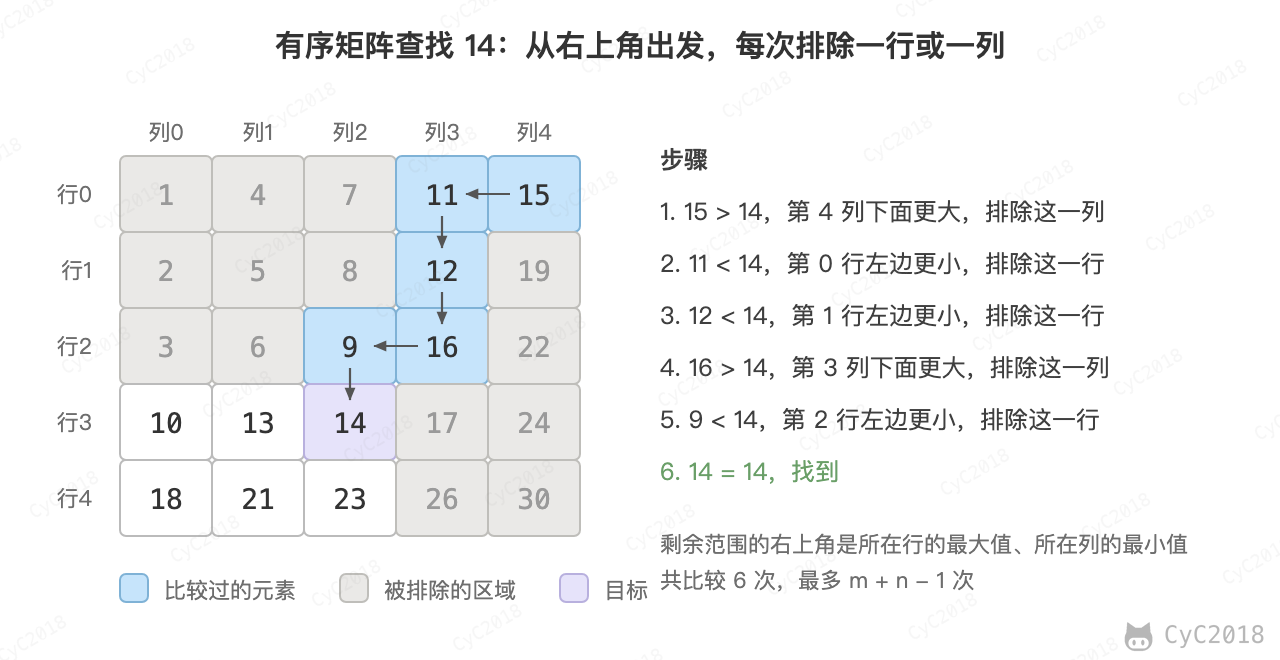
题目描述:矩阵的每一行从左到右递增,每一列从上到下递增,判断 target 是否在矩阵中。
从右上角开始比较。每次比较的元素都位于剩余范围的右上角,是剩余范围内所在行的最大值、所在列的最小值:target 比它小,这一列下面的元素都更大,可以排除这一列;target 比它大,这一行左边的元素都更小,可以排除这一行。每次比较排除一行或一列,时间复杂度为 O(M + N)。
public boolean searchMatrix(int[][] matrix, int target) {
    if (matrix == null || matrix.length == 0 || matrix[0].length == 0) return false;
    int m = matrix.length, n = matrix[0].length;
    int row = 0, col = n - 1;
    while (row < m && col >= 0) {
        if (target == matrix[row][col]) return true;
        else if (target < matrix[row][col]) col--;
        else row++;
    }
    return false;
}
5. 有序矩阵的 Kth Element
378. Kth Smallest Element in a Sorted Matrix (Medium)
matrix = [
  [ 1,  5,  9],
  [10, 11, 13],
  [12, 13, 15]
],
k = 8,

return 13.
解题参考:Share my thoughts and Clean Java Code
二分查找解法:在 [matrix[0][0], matrix[m - 1][n - 1]] 这个值域上二分,统计矩阵中不大于 mid 的元素个数 cnt。cnt < k 说明第 k 小的数比 mid 大,否则不大于 mid。循环结束时 lo 是使 cnt >= k 的最小值,这个值一定是矩阵中的元素。
public int kthSmallest(int[][] matrix, int k) {
    int m = matrix.length, n = matrix[0].length;
    int lo = matrix[0][0], hi = matrix[m - 1][n - 1];
    while (lo <= hi) {
        int mid = lo + (hi - lo) / 2;
        int cnt = 0;
        for (int i = 0; i < m; i++) {
            for (int j = 0; j < n && matrix[i][j] <= mid; j++) {
                cnt++;
            }
        }
        if (cnt < k) lo = mid + 1;
        else hi = mid - 1;
    }
    return lo;
}
堆解法:每一列从上到下递增,可以看成 n 个有序链表做多路归并。先把第一行放入小根堆,每次弹出堆顶后放入它下面的元素,弹出 k - 1 次后堆顶就是第 k 小的数。
public int kthSmallest(int[][] matrix, int k) {
    int m = matrix.length, n = matrix[0].length;
    PriorityQueue<Tuple> pq = new PriorityQueue<Tuple>();
    for(int j = 0; j < n; j++) pq.offer(new Tuple(0, j, matrix[0][j]));
    for(int i = 0; i < k - 1; i++) { // 小根堆,去掉 k - 1 个堆顶元素,此时堆顶元素就是第 k 小的数
        Tuple t = pq.poll();
        if(t.x == m - 1) continue;
        pq.offer(new Tuple(t.x + 1, t.y, matrix[t.x + 1][t.y]));
    }
    return pq.poll().val;
}

class Tuple implements Comparable<Tuple> {
    int x, y, val;
    public Tuple(int x, int y, int val) {
        this.x = x; this.y = y; this.val = val;
    }

    @Override
    public int compareTo(Tuple that) {
        return this.val - that.val;
    }
}
6. 一个数组元素在 [1, n] 之间,其中一个数被替换为另一个数,找出重复的数和丢失的数
645. Set Mismatch (Easy)
Input: nums = [1,2,2,4]
Output: [2,3]
最直接的方法是先对数组进行排序,这种方法时间复杂度为 O(NlogN)。本题可以以 O(N) 的时间复杂度、O(1) 空间复杂度来求解。
主要思想是通过交换数组元素,把值 x 放到下标 x - 1 上:nums[i] 不在正确的位置时,就和它应该去的位置交换,直到当前位置正确或者目标位置上已经是同样的值(说明遇到了重复的数)。放完之后,唯一一个 nums[i] != i + 1 的位置上,nums[i] 是重复的数,i + 1 是丢失的数。例如 [1, 2, 2, 4] 中,下标 2 上是 2,重复的数为 2,丢失的数为 3。
public int[] findErrorNums(int[] nums) {
    for (int i = 0; i < nums.length; i++) {
        while (nums[i] != i + 1 && nums[nums[i] - 1] != nums[i]) {
            swap(nums, i, nums[i] - 1);
        }
    }
    for (int i = 0; i < nums.length; i++) {
        if (nums[i] != i + 1) {
            return new int[]{nums[i], i + 1};
        }
    }
    return null;
}

private void swap(int[] nums, int i, int j) {
    int tmp = nums[i];
    nums[i] = nums[j];
    nums[j] = tmp;
}
7. 找出数组中重复的数,数组值在 [1, n] 之间
287. Find the Duplicate Number (Medium)
要求不能修改数组,也不能使用额外的空间。
二分查找解法:对值域 [1, n] 二分,统计数组中不大于 mid 的元素个数 cnt。重复的数大于 mid 时,1 ~ mid 中每个数最多出现一次,cnt 不超过 mid;重复的数不大于 mid 时,大于 mid 的每个数最多出现一次,这类元素最多 n - mid 个,数组共 n + 1 个元素,cnt 至少为 mid + 1。因此 cnt > mid 说明重复的数在 [1, mid] 中,否则在 [mid + 1, n] 中。例如 [1, 3, 4, 2, 2] 中 mid = 2 时 cnt = 3,重复的数不大于 2。时间复杂度为 O(NlogN)。
public int findDuplicate(int[] nums) {
     int l = 1, h = nums.length - 1;
     while (l <= h) {
         int mid = l + (h - l) / 2;
         int cnt = 0;
         for (int i = 0; i < nums.length; i++) {
             if (nums[i] <= mid) cnt++;
         }
         if (cnt > mid) h = mid - 1;
         else l = mid + 1;
     }
     return l;
}
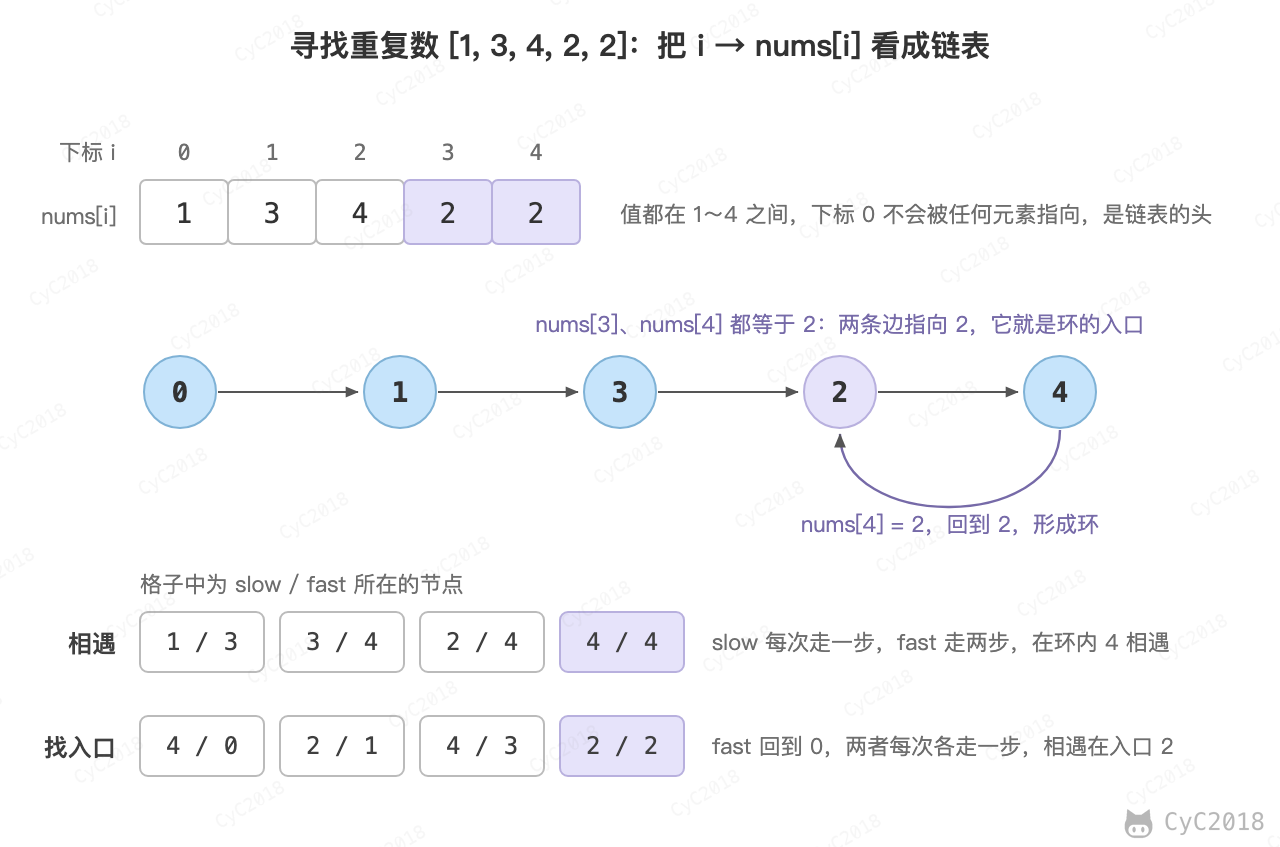
双指针解法:把 i → nums[i] 看成链表中的一条边。从下标 0 出发沿边一直走,每一步都落在 [1, n] 的下标上,不会停下,有限个节点中必然会进入环。环的入口至少有两条边指向它(来自环外和环内),也就是至少有两个下标上的值等于它,所以入口就是重复的数。用快慢指针先在环内相遇,再让一个指针回到起点,两个指针每次各走一步,相遇处就是环的入口,与剑指 Offer 23 链表中环的入口结点的做法相同。时间复杂度为 O(N)。
public int findDuplicate(int[] nums) {
    int slow = nums[0], fast = nums[nums[0]];
    while (slow != fast) {
        slow = nums[slow];
        fast = nums[nums[fast]];
    }
    fast = 0;
    while (slow != fast) {
        slow = nums[slow];
        fast = nums[fast];
    }
    return slow;
}
8. 数组相邻差值的个数
667. Beautiful Arrangement II (Medium)
Input: n = 3, k = 2
Output: [1, 3, 2]
Explanation: The [1, 3, 2] has three different positive integers ranging from 1 to 3, and the [2, 1] has exactly 2 distinct integers: 1 and 2.
题目描述:数组元素为 1~n 的整数,要求构建数组,使得相邻元素的差值不相同的个数为 k。
让前 k+1 个元素构建出 k 个不相同的差值,序列为:1 k+1 2 k 3 k-1 ... k/2 k/2+1,相邻差值依次为 k、k-1、……、1。之后的元素按 k+2、k+3、……、n 递增排列,内部的差值都是 1;前一段的最后一个元素在 k/2 附近,与 k+2 的差值不超过 k,也已经出现过,因此不会产生新的差值。例如 n = 5、k = 3 时得到 [1, 4, 2, 3, 5],差值为 3、2、1、2,衔接处 3 → 5 的差值 2 已经出现过。
public int[] constructArray(int n, int k) {
    int[] ret = new int[n];
    ret[0] = 1;
    for (int i = 1, interval = k; i <= k; i++, interval--) {
        ret[i] = i % 2 == 1 ? ret[i - 1] + interval : ret[i - 1] - interval;
    }
    for (int i = k + 1; i < n; i++) {
        ret[i] = i + 1;
    }
    return ret;
}
9. 数组的度
697. Degree of an Array (Easy)
Input: [1,2,2,3,1,4,2]
Output: 6
题目描述:数组的度定义为元素出现的最高频率,例如上面的数组度为 3。要求找到一个最小的子数组,这个子数组的度和原数组一样。
子数组的度要和原数组一样,就要包含某个出现次数最多的元素的全部出现位置,最短的就是从它第一次出现到最后一次出现的一段。记录每个元素的出现次数、第一次和最后一次出现的位置,在出现次数最多的元素中取这段长度的最小值。上面的数组中 2 出现 3 次,位置 1 到 6,答案为 6。
public int findShortestSubArray(int[] nums) {
    Map<Integer, Integer> numsCnt = new HashMap<>();
    Map<Integer, Integer> numsLastIndex = new HashMap<>();
    Map<Integer, Integer> numsFirstIndex = new HashMap<>();
    for (int i = 0; i < nums.length; i++) {
        int num = nums[i];
        numsCnt.put(num, numsCnt.getOrDefault(num, 0) + 1);
        numsLastIndex.put(num, i);
        if (!numsFirstIndex.containsKey(num)) {
            numsFirstIndex.put(num, i);
        }
    }
    int maxCnt = 0;
    for (int num : nums) {
        maxCnt = Math.max(maxCnt, numsCnt.get(num));
    }
    int ret = nums.length;
    for (int i = 0; i < nums.length; i++) {
        int num = nums[i];
        int cnt = numsCnt.get(num);
        if (cnt != maxCnt) continue;
        ret = Math.min(ret, numsLastIndex.get(num) - numsFirstIndex.get(num) + 1);
    }
    return ret;
}
10. 对角元素相等的矩阵
766. Toeplitz Matrix (Easy)
1234
5123
9512

In the above grid, the diagonals are "[9]", "[5, 5]", "[1, 1, 1]", "[2, 2, 2]", "[3, 3]", "[4]", and in each diagonal all elements are the same, so the answer is True.
public boolean isToeplitzMatrix(int[][] matrix) {
    for (int i = 0; i < matrix[0].length; i++) {
        if (!check(matrix, matrix[0][i], 0, i)) {
            return false;
        }
    }
    for (int i = 0; i < matrix.length; i++) {
        if (!check(matrix, matrix[i][0], i, 0)) {
            return false;
        }
    }
    return true;
}

private boolean check(int[][] matrix, int expectValue, int row, int col) {
    if (row >= matrix.length || col >= matrix[0].length) {
        return true;
    }
    if (matrix[row][col] != expectValue) {
        return false;
    }
    return check(matrix, expectValue, row + 1, col + 1);
}
11. 嵌套数组
565. Array Nesting (Medium)
Input: A = [5,4,0,3,1,6,2]
Output: 4
Explanation:
A[0] = 5, A[1] = 4, A[2] = 0, A[3] = 3, A[4] = 1, A[5] = 6, A[6] = 2.

One of the longest S[K]:
S[0] = {A[0], A[5], A[6], A[2]} = {5, 6, 2, 0}
题目描述:S[i] 表示一个集合,集合的第一个元素是 A[i],第二个元素是 A[A[i]],如此嵌套下去。求最大的 S[i]。
数组是 0 ~ n-1 的一个排列,每个下标只被一个元素指向,所以 i → A[i] 把数组分成若干个互不相交的环,S[i] 就是 i 所在的环。同一个环上的起点得到的集合大小相同,遍历过的位置标记为 -1 后不再访问,每个元素只访问一次,时间复杂度为 O(N)。
public int arrayNesting(int[] nums) {
    int max = 0;
    for (int i = 0; i < nums.length; i++) {
        int cnt = 0;
        for (int j = i; nums[j] != -1; ) {
            cnt++;
            int t = nums[j];
            nums[j] = -1; // 标记该位置已经被访问
            j = t;

        }
        max = Math.max(max, cnt);
    }
    return max;
}
12. 分隔数组
769. Max Chunks To Make Sorted (Medium)
Input: arr = [1,0,2,3,4]
Output: 4
Explanation:
We can split into two chunks, such as [1, 0], [2, 3, 4].
However, splitting into [1, 0], [2], [3], [4] is the highest number of chunks possible.
题目描述:arr 是 0 ~ n-1 的一个排列,把它分成尽量多的块,使得对每块分别排序后整个数组有序。
前 i + 1 个元素能单独成为若干块,当且仅当它们恰好是 0 ~ i,也就是前缀的最大值等于 i。从左往右维护前缀最大值 right,每遇到 right == i 就可以切一刀。例如 [1, 0, 2, 3, 4] 在下标 1、2、3、4 处都满足条件,答案为 4。
public int maxChunksToSorted(int[] arr) {
    if (arr == null) return 0;
    int ret = 0;
    int right = arr[0];
    for (int i = 0; i < arr.length; i++) {
        right = Math.max(right, arr[i]);
        if (right == i) ret++;
    }
    return ret;
}
13. 合并区间
56. Merge Intervals (Medium)
Input: [[1, 3], [2, 6], [8, 10], [15, 18]]
Output: [[1, 6], [8, 10], [15, 18]]
按区间的左端点排序后,能合并的区间一定是相邻的。依次检查每个区间:如果它的左端点不超过结果中最后一个区间的右端点,就把两者合并;否则作为一个新区间加入结果。
public int[][] merge(int[][] intervals) {
    Arrays.sort(intervals, (a, b) -> Integer.compare(a[0], b[0]));
    List<int[]> ret = new ArrayList<>();
    for (int[] cur : intervals) {
        if (!ret.isEmpty() && cur[0] <= ret.get(ret.size() - 1)[1]) {
            int[] last = ret.get(ret.size() - 1);
            last[1] = Math.max(last[1], cur[1]);
        } else {
            ret.add(cur);
        }
    }
    return ret.toArray(new int[ret.size()][]);
}
时间复杂度为 O(NlogN),主要花在排序上,排序后只扫描一遍;除结果外,对象数组排序使用的 TimSort 最多需要 O(N) 的辅助空间。
14. 下一个排列
31. Next Permutation (Medium)
Input: [1, 2, 3]    Output: [1, 3, 2]
Input: [3, 2, 1]    Output: [1, 2, 3]
题目描述:把数组原地重排为字典序中下一个更大的排列,如果已经是最大的排列,就重排为最小的排列。
要让排列变大又变得尽量少,应该修改尽量靠右的位置:
- 从右往左找到第一个满足 nums[i] < nums[i + 1] 的位置 i,i 右边是一段降序,已经是这一段能组成的最大排列;
- 从右往左找到第一个大于 nums[i] 的元素 nums[j],交换两者,i 位置变大了一点;
- 交换后 i 右边仍然是降序,把它反转为升序,使这一段尽量小。
1 5 8 4 7 6 5 3 1
      i     j
交换:1 5 8 5 7 6 4 3 1
反转:1 5 8 5 1 3 4 6 7
public void nextPermutation(int[] nums) {
    int i = nums.length - 2;
    while (i >= 0 && nums[i] >= nums[i + 1]) {
        i--;
    }
    if (i >= 0) {
        int j = nums.length - 1;
        while (nums[j] <= nums[i]) {
            j--;
        }
        swap(nums, i, j);
    }
    for (int l = i + 1, r = nums.length - 1; l < r; l++, r--) {
        swap(nums, l, r);
    }
}

private void swap(int[] nums, int i, int j) {
    int t = nums[i];
    nums[i] = nums[j];
    nums[j] = t;
}