Leetcode 题解 - 链表
本文目录
链表是空节点,或者有一个值和一个指向下一个链表的指针,因此很多链表问题可以用递归来处理。
1. 找出两个链表的交点
160. Intersection of Two Linked Lists (Easy)
例如以下示例中 A 和 B 两个链表相交于 c1:
A:          a1 → a2
                    ↘
                      c1 → c2 → c3
                    ↗
B:    b1 → b2 → b3
但是不会出现以下相交的情况,因为每个节点只有一个 next 指针,也就只能有一个后继节点,而以下示例中节点 c 有两个后继节点。
A:          a1 → a2       d1 → d2
                    ↘  ↗
                      c
                    ↗  ↘
B:    b1 → b2 → b3        e1 → e2
要求时间复杂度为 O(N),空间复杂度为 O(1)。如果不存在交点则返回 null。
两个指针同时出发,难点在于 A、B 交点前的长度不同,指针不会同时到达交点。解决方法是让每个指针走完自己的链表后,接着从另一个链表的头部走:
设 A 的长度为 a + c,B 的长度为 b + c,其中 c 为尾部公共部分长度。指针 l1 走完 A 再走 B 的前 b 个节点,指针 l2 走完 B 再走 A 的前 a 个节点,两者走的步数都是 a + c + b,因此会同时到达交点。以上面的例子 a = 2、b = 3、c = 3 为例,两个指针都在第 9 步到达 c1(null 也算一步):
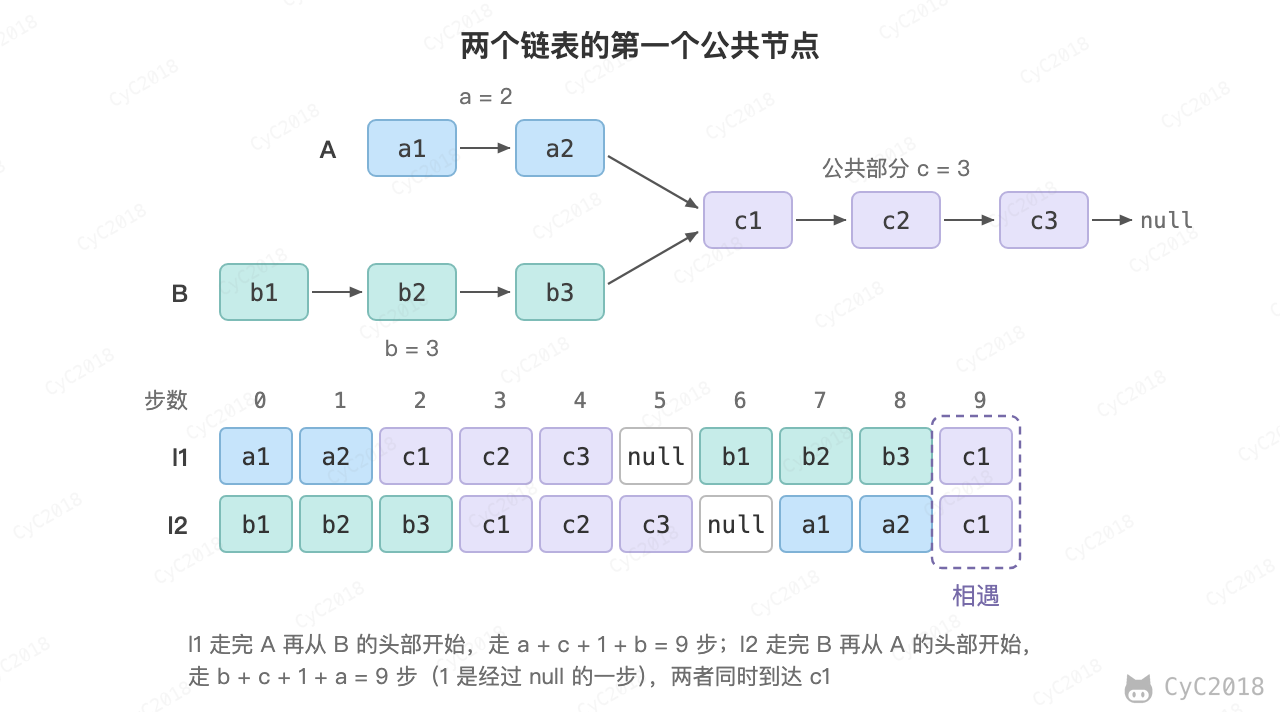
如果不存在交点,两个指针都走完 A、B 两个链表后同时为 null,从而退出循环。
public ListNode getIntersectionNode(ListNode headA, ListNode headB) {
    ListNode l1 = headA, l2 = headB;
    while (l1 != l2) {
        l1 = (l1 == null) ? headB : l1.next;
        l2 = (l2 == null) ? headA : l2.next;
    }
    return l1;
}
如果只是判断是否存在交点,那么就是另一个问题,即《编程之美》3.6 的问题。有两种解法:
- 把第一个链表的结尾连接到第二个链表的开头,看第二个链表是否存在环;
- 或者直接比较两个链表的最后一个节点是否相同。
2. 链表反转
206. Reverse Linked List (Easy)
递归:先把 head.next 之后的部分反转,返回新的头节点;此时 next 是反转后那一段的尾节点,把 head 接在 next 后面,再断开 head 原来的 next 指针。例如 1→2→3,反转 2→3 得到 3→2 后,令 2.next = 1、1.next = null,得到 3→2→1。
public ListNode reverseList(ListNode head) {
    if (head == null || head.next == null) {
        return head;
    }
    ListNode next = head.next;
    ListNode newHead = reverseList(next);
    next.next = head;
    head.next = null;
    return newHead;
}
头插法(迭代):从头到尾取下每个节点,插到虚拟头节点 newHead 的后面,先取下的节点会被后取下的节点挤到后面,因此顺序反转。newHead.next 相当于常见写法中指向已反转部分的 pre 指针。每一步要先用 next 记住 head.next 再修改 head.next,否则后面的链表就丢了。迭代只需要 O(1) 的额外空间,递归需要 O(N) 的栈空间,以 1 -> 2 -> 3 为例的逐步过程见剑指 Offer 24。
public ListNode reverseList(ListNode head) {
    ListNode newHead = new ListNode(-1);
    while (head != null) {
        ListNode next = head.next;
        head.next = newHead.next;
        newHead.next = head;
        head = next;
    }
    return newHead.next;
}
3. 归并两个有序的链表
21. Merge Two Sorted Lists (Easy)
比较两个链表的头节点,较小的那个作为结果的头节点,它的 next 指向剩余部分归并的结果。递归最坏需要 O(m + n) 的栈空间(m、n 为两个链表的长度),链表很长时可以改用迭代:用虚拟头节点 dummy 和尾指针 tail,每次把较小的节点接到 tail 后面,代码见链表排序中的 merge()。
public ListNode mergeTwoLists(ListNode l1, ListNode l2) {
    if (l1 == null) return l2;
    if (l2 == null) return l1;
    if (l1.val < l2.val) {
        l1.next = mergeTwoLists(l1.next, l2);
        return l1;
    } else {
        l2.next = mergeTwoLists(l1, l2.next);
        return l2;
    }
}
4. 从有序链表中删除重复节点
83. Remove Duplicates from Sorted List (Easy)
Given 1->1->2, return 1->2.
Given 1->1->2->3->3, return 1->2->3.
先递归处理 head.next 之后的部分,返回时如果 head 与后继节点的值相同,就丢掉 head、返回后继节点。
public ListNode deleteDuplicates(ListNode head) {
    if (head == null || head.next == null) return head;
    head.next = deleteDuplicates(head.next);
    return head.val == head.next.val ? head.next : head;
}
5. 删除链表的倒数第 n 个节点
19. Remove Nth Node From End of List (Medium)
Given linked list: 1->2->3->4->5, and n = 2.
After removing the second node from the end, the linked list becomes 1->2->3->5.
fast 先走 n 步,然后 fast 和 slow 一起走,fast 到达最后一个节点时,slow 正好停在倒数第 n 个节点的前一个节点上。例如 n = 2 时 fast 停在 5,slow 停在 3,令 3.next = 5 即可。如果 fast 先走 n 步后就为 null,说明要删除的是头节点。
public ListNode removeNthFromEnd(ListNode head, int n) {
    ListNode fast = head;
    while (n-- > 0) {
        fast = fast.next;
    }
    if (fast == null) return head.next;
    ListNode slow = head;
    while (fast.next != null) {
        fast = fast.next;
        slow = slow.next;
    }
    slow.next = slow.next.next;
    return head;
}
6. 交换链表中的相邻结点
24. Swap Nodes in Pairs (Medium)
Given 1->2->3->4, you should return the list as 2->1->4->3.
题目要求:不能修改节点的 val 值,只能改变节点之间的指针。
pre 指向待交换的两个节点 l1、l2 的前一个节点,依次令 l1 指向 l2 的后继、l2 指向 l1、pre 指向 l2,交换后 l1 在后面,作为下一对的 pre。
public ListNode swapPairs(ListNode head) {
    ListNode node = new ListNode(-1);
    node.next = head;
    ListNode pre = node;
    while (pre.next != null && pre.next.next != null) {
        ListNode l1 = pre.next, l2 = pre.next.next;
        ListNode next = l2.next;
        l1.next = next;
        l2.next = l1;
        pre.next = l2;

        pre = l1;
    }
    return node.next;
}
7. 链表求和
445. Add Two Numbers II (Medium)
Input: (7 -> 2 -> 4 -> 3) + (5 -> 6 -> 4)
Output: 7 -> 8 -> 0 -> 7
进阶要求:不能反转输入的链表。
链表的高位在前,而加法要从低位开始算。把两个链表的值分别压入栈中,出栈的顺序就是从低位到高位;每一位的结果用头插法插到结果链表的前面。
public ListNode addTwoNumbers(ListNode l1, ListNode l2) {
    Stack<Integer> l1Stack = buildStack(l1);
    Stack<Integer> l2Stack = buildStack(l2);
    ListNode head = new ListNode(-1);
    int carry = 0;
    while (!l1Stack.isEmpty() || !l2Stack.isEmpty() || carry != 0) {
        int x = l1Stack.isEmpty() ? 0 : l1Stack.pop();
        int y = l2Stack.isEmpty() ? 0 : l2Stack.pop();
        int sum = x + y + carry;
        ListNode node = new ListNode(sum % 10);
        node.next = head.next;
        head.next = node;
        carry = sum / 10;
    }
    return head.next;
}

private Stack<Integer> buildStack(ListNode l) {
    Stack<Integer> stack = new Stack<>();
    while (l != null) {
        stack.push(l.val);
        l = l.next;
    }
    return stack;
}
8. 回文链表
234. Palindrome Linked List (Easy)
进阶要求:以 O(1) 的空间复杂度来求解。
用快慢指针找到中点后切成两半,把后半段反转,然后比较两半是否相等。节点数为奇数时,中间的节点分到后半段,比较到前半段结束为止。这种做法会断开并改动输入的链表,需要保持原状时,比较后把后半段再反转一次,接回前半段的末尾。
public boolean isPalindrome(ListNode head) {
    if (head == null || head.next == null) return true;
    ListNode slow = head, fast = head.next;
    while (fast != null && fast.next != null) {
        slow = slow.next;
        fast = fast.next.next;
    }
    if (fast != null) slow = slow.next;  // 偶数节点,让 slow 指向下一个节点
    cut(head, slow);                     // 切成两个链表
    return isEqual(head, reverse(slow));
}

private void cut(ListNode head, ListNode cutNode) {
    while (head.next != cutNode) {
        head = head.next;
    }
    head.next = null;
}

private ListNode reverse(ListNode head) {
    ListNode newHead = null;
    while (head != null) {
        ListNode nextNode = head.next;
        head.next = newHead;
        newHead = head;
        head = nextNode;
    }
    return newHead;
}

private boolean isEqual(ListNode l1, ListNode l2) {
    while (l1 != null && l2 != null) {
        if (l1.val != l2.val) return false;
        l1 = l1.next;
        l2 = l2.next;
    }
    return true;
}
9. 分隔链表
725. Split Linked List in Parts (Medium)
Input:
head = [1, 2, 3, 4, 5, 6, 7, 8, 9, 10], k = 3
Output: [[1, 2, 3, 4], [5, 6, 7], [8, 9, 10]]
Explanation:
The input has been split into consecutive parts with size difference at most 1, and earlier parts are a larger size than the later parts.
题目描述:把链表分隔成 k 部分,每部分的长度都应该尽可能相同,排在前面的长度应该大于等于后面的。
设链表长度为 N,每部分至少 N / k 个节点,前 N % k 部分各多 1 个。例如 N = 10、k = 3 时,三部分的长度为 4、3、3。
public ListNode[] splitListToParts(ListNode head, int k) {
    int N = 0;
    ListNode cur = head;
    while (cur != null) {
        N++;
        cur = cur.next;
    }
    int mod = N % k;
    int size = N / k;
    ListNode[] ret = new ListNode[k];
    cur = head;
    for (int i = 0; cur != null && i < k; i++) {
        ret[i] = cur;
        int curSize = size + (mod-- > 0 ? 1 : 0);
        for (int j = 0; j < curSize - 1; j++) {
            cur = cur.next;
        }
        ListNode next = cur.next;
        cur.next = null;
        cur = next;
    }
    return ret;
}
10. 链表元素按奇偶聚集
328. Odd Even Linked List (Medium)
Example:
Given 1->2->3->4->5->NULL,
return 1->3->5->2->4->NULL.
odd 和 even 分别串起奇数位置和偶数位置的节点,交替向后跳一个节点,最后把偶数链表接在奇数链表的后面。
public ListNode oddEvenList(ListNode head) {
    if (head == null) {
        return head;
    }
    ListNode odd = head, even = head.next, evenHead = even;
    while (even != null && even.next != null) {
        odd.next = odd.next.next;
        odd = odd.next;
        even.next = even.next.next;
        even = even.next;
    }
    odd.next = evenHead;
    return head;
}
11. K 个一组翻转链表
25. Reverse Nodes in k-Group (Hard)
Input: 1->2->3->4->5, k = 2
Output: 2->1->4->3->5
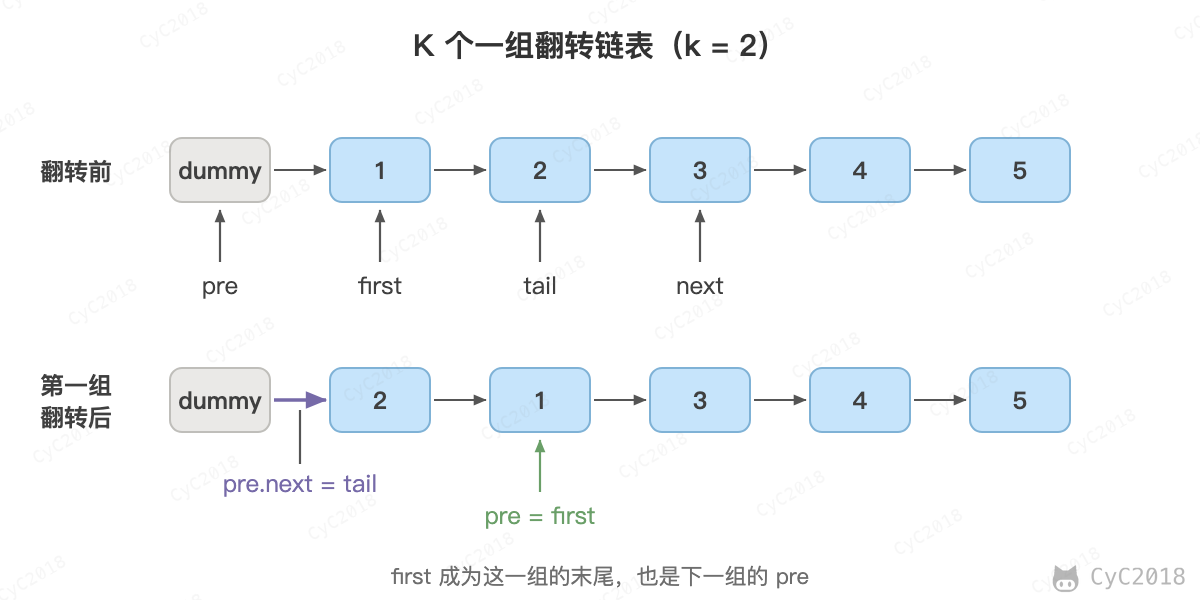
题目描述:每 k 个节点一组进行翻转,最后不足 k 个的节点保持原有顺序。如果要求不足 k 个也翻转,走不到 k 步时把剩下的部分同样翻转即可。
使用一个虚拟头节点 dummy,pre 指向下一组的前一个节点。先从 pre 向后走 k 步找到这一组的尾节点 tail,走不到说明剩余节点不足 k 个。然后把 pre.next 到 tail 这一段原地翻转,再把它接回原链表,最后 pre 移到这一组翻转后的末尾。翻转时 prev 的初始值是下一组的头节点 next 而不是 null,这样翻转完之后这一组原来的头节点 first 已经接在下一组前面,只需要再令 pre.next = tail。
public ListNode reverseKGroup(ListNode head, int k) {
    ListNode dummy = new ListNode(-1);
    dummy.next = head;
    ListNode pre = dummy;
    while (true) {
        ListNode tail = pre;
        for (int i = 0; i < k && tail != null; i++) {
            tail = tail.next;
        }
        if (tail == null) {
            break;
        }
        ListNode first = pre.next, next = tail.next;
        ListNode prev = next, cur = first;
        while (cur != next) {
            ListNode tmp = cur.next;
            cur.next = prev;
            prev = cur;
            cur = tmp;
        }
        pre.next = tail;
        pre = first;
    }
    return dummy.next;
}
每个节点在找尾节点时被访问一次、翻转时再被访问一次,时间复杂度 O(N);只用了几个指针,空间复杂度 O(1)。
12. 重排链表
143. Reorder List (Medium)
Input: 1->2->3->4->5
Output: 1->5->2->4->3
题目描述:把 L0→L1→…→Ln 重排为 L0→Ln→L1→Ln-1→…,只能修改节点的指针。
可以拆成三个已经解决过的子问题:用快慢指针找到中点并断开;把后半段反转;再把两段交替连接起来。
public void reorderList(ListNode head) {
    if (head == null || head.next == null) {
        return;
    }
    ListNode slow = head, fast = head;
    while (fast.next != null && fast.next.next != null) {
        slow = slow.next;
        fast = fast.next.next;
    }
    ListNode l2 = reverse(slow.next);
    slow.next = null;
    ListNode l1 = head;
    while (l2 != null) {
        ListNode n1 = l1.next, n2 = l2.next;
        l1.next = l2;
        l2.next = n1;
        l1 = n1;
        l2 = n2;
    }
}

private ListNode reverse(ListNode head) {
    ListNode pre = null;
    while (head != null) {
        ListNode next = head.next;
        head.next = pre;
        pre = head;
        head = next;
    }
    return pre;
}
找中点、反转后半段、交替连接各遍历一次链表,时间复杂度 O(N);只修改指针,空间复杂度 O(1)。
13. 合并 K 个有序链表
23. Merge k Sorted Lists (Hard)
用小顶堆保存每个链表当前的头节点,每次取出值最小的节点接到结果链表后面,再把它的下一个节点放入堆中。设一共有 N 个节点,每个节点进出堆一次,时间复杂度为 O(NlogK)。
也可以像归并排序那样两两合并:第一轮把 K 个链表合并成 K / 2 个,第二轮合并成 K / 4 个,一共 logK 轮,每轮处理 N 个节点,时间复杂度同样是 O(NlogK)。需要注意的是,如果依次把每个链表合并到同一个结果链表上,前面的节点会被反复扫描,时间复杂度为 O(NK)。
public ListNode mergeKLists(ListNode[] lists) {
    PriorityQueue<ListNode> pq = new PriorityQueue<>((a, b) -> Integer.compare(a.val, b.val));
    for (ListNode node : lists) {
        if (node != null) {
            pq.add(node);
        }
    }
    ListNode dummy = new ListNode(-1), tail = dummy;
    while (!pq.isEmpty()) {
        ListNode node = pq.poll();
        tail.next = node;
        tail = node;
        if (node.next != null) {
            pq.add(node.next);
        }
    }
    return dummy.next;
}
14. 链表排序
148. Sort List (Medium)
题目描述:在 O(NlogN) 时间复杂度内对链表进行排序。
链表不能随机访问,适合用归并排序:用快慢指针找到中点断开,两半分别排序后,用归并两个有序的链表的方法归并。递归需要 O(logN) 的栈空间。
public ListNode sortList(ListNode head) {
    if (head == null || head.next == null) {
        return head;
    }
    ListNode slow = head, fast = head.next;
    while (fast != null && fast.next != null) {
        slow = slow.next;
        fast = fast.next.next;
    }
    ListNode right = slow.next;
    slow.next = null;
    return merge(sortList(head), sortList(right));
}

private ListNode merge(ListNode l1, ListNode l2) {
    ListNode dummy = new ListNode(-1), tail = dummy;
    while (l1 != null && l2 != null) {
        if (l1.val <= l2.val) {
            tail.next = l1;
            l1 = l1.next;
        } else {
            tail.next = l2;
            l2 = l2.next;
        }
        tail = tail.next;
    }
    tail.next = l1 != null ? l1 : l2;
    return dummy.next;
}
参考资料
- LeetCode 题库
- 《编程之美》小组. 编程之美 [M]. 电子工业出版社, 2008.